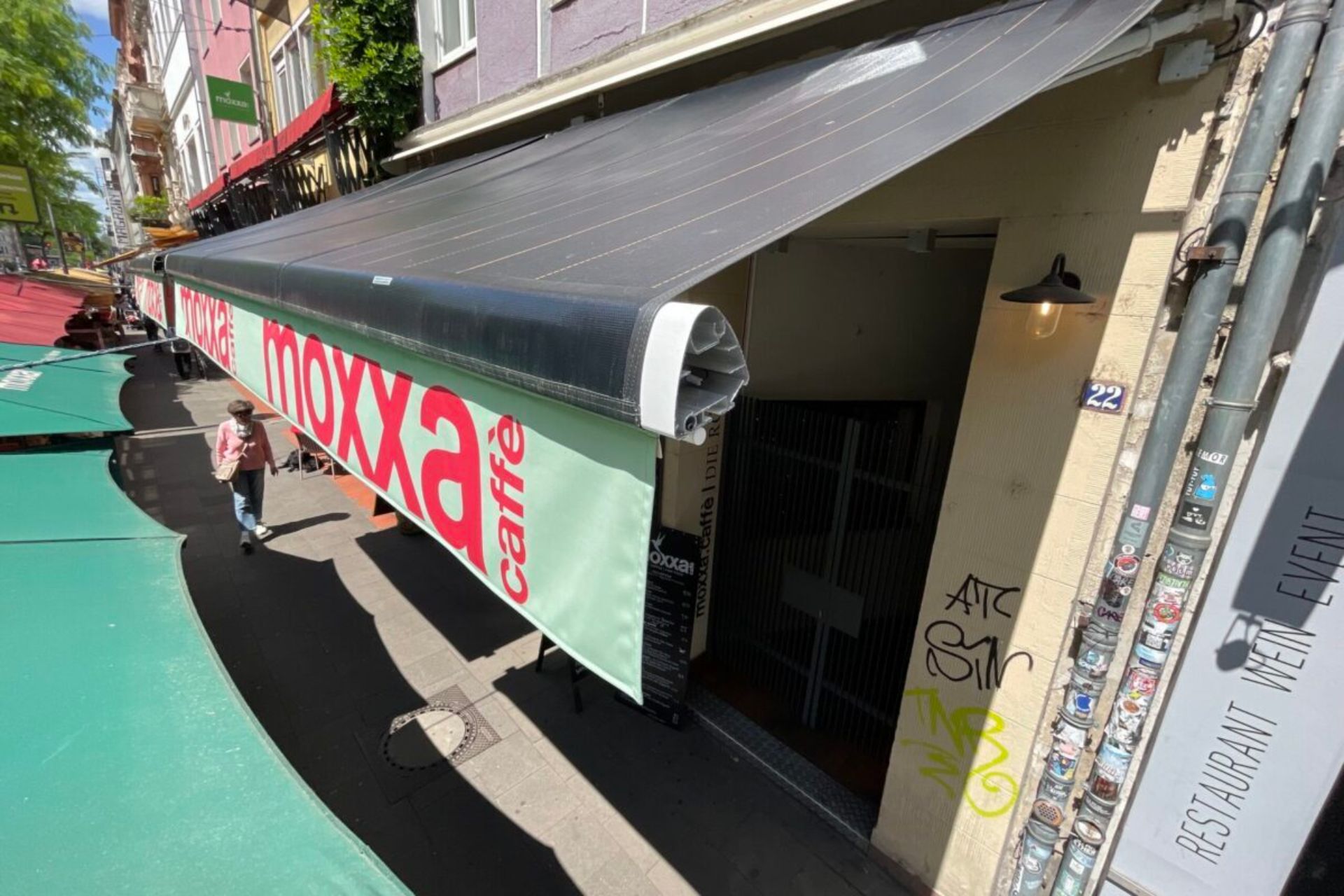
A German startup has turned an everyday patio awning into a small solar power plant, allowing homes and businesses to create shade and electricity from the same exterior surface.
Developed by Essen-based SolarMarkise, the system replaces an ordinary awning fabric with a flexible photovoltaic material mounted on an aluminum folding-arm frame. It extends and retracts like a conventional powered awning, but its embedded monocrystalline solar cells continue generating electricity whenever the fabric is open in sunlight.
The electricity passes through an inverter and into the building through a standard electrical connection. In Germany, the system is treated as a plug-in balcony power plant, with grid delivery limited to 800 W. The greater panel capacity helps it reach that limit during more of the day, while electricity not immediately consumed can be directed to an optional battery.
Two sizes for homes and businesses
SolarMarkise currently offers two versions. The M model measures 3.51 m wide by 3 m deep (11.5 by 9.8 ft) and has a peak capacity of 1.35 kW. The larger L model measures 4.35 m by 3 m (14.3 by 9.8 ft) and increases peak output to 1.8 kW.
The company estimates annual generation of up to 1,200 kWh from the M and 1,600 kWh from the L, assuming a south-facing, unshaded installation. Actual production will depend on location, orientation, mounting angle, weather, shading and how frequently the awning remains extended.
The flexible solar material is listed at 1.6 mm thick and 2.2 kg per square meter. SolarMarkise says it can be rolled through 360 degrees and operated more than 10,000 times. The original product data also lists 15% module efficiency, waterproof construction and complete UV protection.
Both models include a radio-controlled motor and wind sensor. The published specifications say an extended awning can withstand winds up to Beaufort force 5, but the company describes the product primarily as sun protection and recommends retracting it during stronger wind or poor weather. The sensor can automatically close the awning when conditions become unsuitable.
Solar power without using the roof
The concept is particularly relevant where the roof is unsuitable, shaded, rented or already occupied. A solar awning can instead use the facade above a balcony, terrace, restaurant seating area or storefront.
Its production pattern may also suit businesses with high daytime electricity use. Restaurants, for example, can shade customers while using the generated power for refrigeration, lighting, coffee machines or air conditioning.
SolarMarkise completed early pilot installations at private homes and commercial locations, including a café in Cologne where two awnings provide shade above outdoor seating. The startup says the systems are developed in Germany, with final assembly and preparation performed at its workshop in Essen.
Pricing and availability
The SolarMarkise M is currently listed from €4,499, while the L starts at €5,499. These are self-installation prices that include the powered awning, photovoltaic fabric and wind sensor; professional installation, storage and other accessories can increase the total.
SolarMarkise offers delivery within Germany and optional installation through regional partners. The company provides a 10-year warranty on the awning mechanism and photovoltaic fabric.
This is more expensive than simply installing a conventional awning, and an unobstructed rooftop solar array will normally offer more generating area. But where shade is already needed and usable roof space is limited, combining the two functions could make an otherwise passive surface contribute to the building’s electricity supply.
Source: SolarMarkise