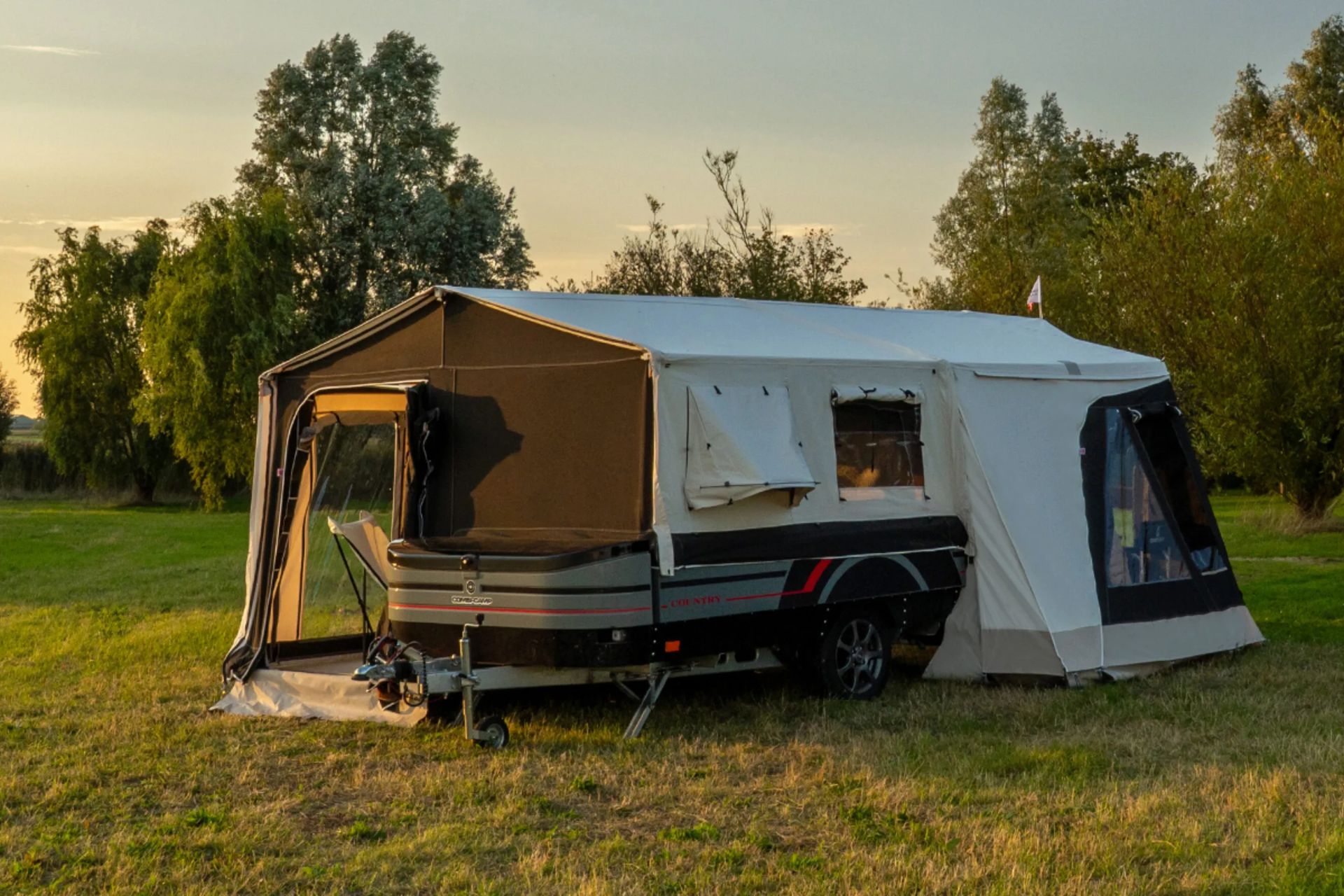
Setting up camp usually means poles, pegs, guy ropes, ground sheets and a fair amount of patience. The Combi-Camp Country takes a very different approach.
At first glance, it looks like a relatively compact luggage trailer. Unhitch it, start unfolding, and the trailer itself becomes the foundation of a raised tent complete with a solid floor and a proper bed.
According to Combi-Camp, the Country’s basic sleeping area can be ready in less than one minute, and it does not require tent pegs or guy ropes for that initial setup. The rigid trailer base provides the structure, while the tent and sleeping platform unfold as part of the same system.
For campers who frequently move from one location to another, that could be the Country’s biggest attraction. Instead of spending a significant part of every arrival and departure assembling a conventional tent, the main shelter is essentially built into the trailer.
From small trailer to raised campsite
The transformation starts by opening the trailer and folding its structure outward. As the sections move into position, the canvas tent rises with them and the trailer creates a fixed floor above the ground.
That is an important distinction from most tents. Rather than sleeping on a groundsheet placed directly on grass, dirt or gravel, occupants get a rigid platform beneath their feet.
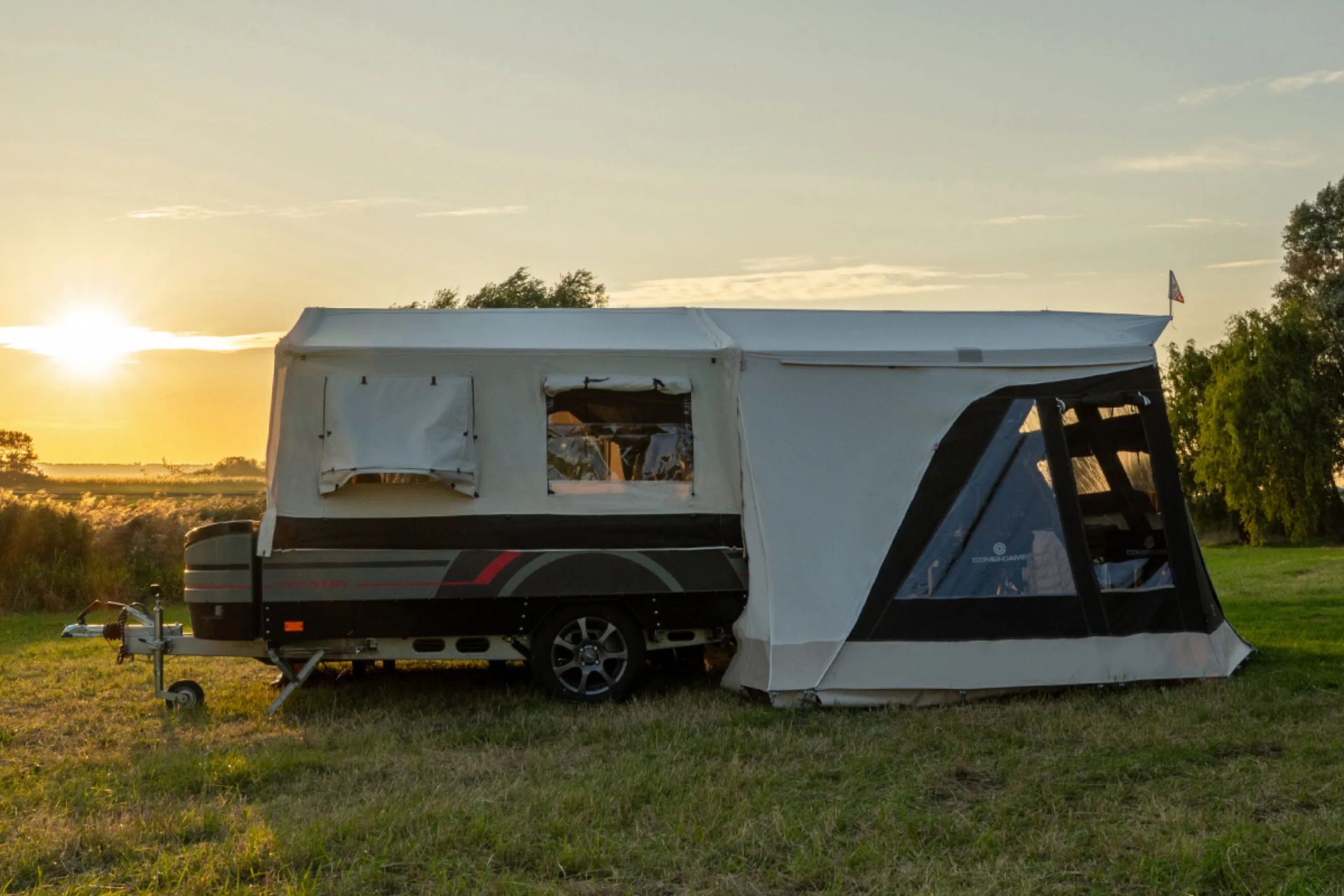
Combi-Camp specifically promotes the Country as a lightweight, compact trailer designed for campers who travel frequently. The company also lists its combination of quick setup, solid flooring and peg-free basic pitching among the model’s defining features.
Once the base tent is open, campers who want more living space can add the supplied awning. The standard package includes the canopy along with front and side panels, creating a substantially larger sheltered area around the core sleeping compartment.
The awning itself measures 440 × 320 cm (about 14.4 × 10.5 ft).
There’s a king-size bed inside
The quick setup does not mean sleeping on a thin camping mat.
The standard Country comes with a 160 × 215 cm (63 × 85 in) king-size bed and a slatted base. The sleeping area is integrated into the trailer, meaning the bed becomes available as the structure is unfolded rather than having to be assembled separately after the tent goes up.
There is also a Twin configuration for campers who would rather sleep lengthwise. Instead of the standard bed, it uses two beds positioned side by side, each measuring 120 × 210 cm (47 × 83 in).

The sleeping platform can also be converted into a sofa, creating an indoor seating area when the bed is not being used.
Combi-Camp positions the basic Country primarily as a trailer tent for two people, but there is room for two children to sleep on the solid floor. With an additional guest cabin and rear awning, the setup can be expanded to accommodate up to seven people.
A surprising amount of storage
One of the advantages of building the sleeping platform on top of the trailer is the amount of space available underneath it.
The Country provides 1,450 liters (51.2 cu ft) of luggage capacity, with the main storage compartment positioned beneath the bed. The compartment itself measures approximately 240 × 150 × 30 cm (94 × 59 × 12 in).
That means chairs, bags, cooking equipment and other camping gear can remain stored beneath the sleeping area rather than taking up floor space inside the tent.
A lightweight roof rack is also included. Combi-Camp says it can be used to transport gear such as bicycles, a small boat or a surfboard.
For anyone needing even more capacity, an optional storage box can be fitted to the drawbar. That adds another 300 liters (10.6 cu ft) of storage.
You can even get one with a kitchen
The Country is sold in versions both with and without an integrated kitchen.
The kitchen-equipped model adds a three-burner gas stove with a cover, a sink and tap, electrical outlets, drawers and cupboards. A refrigerator is optional.
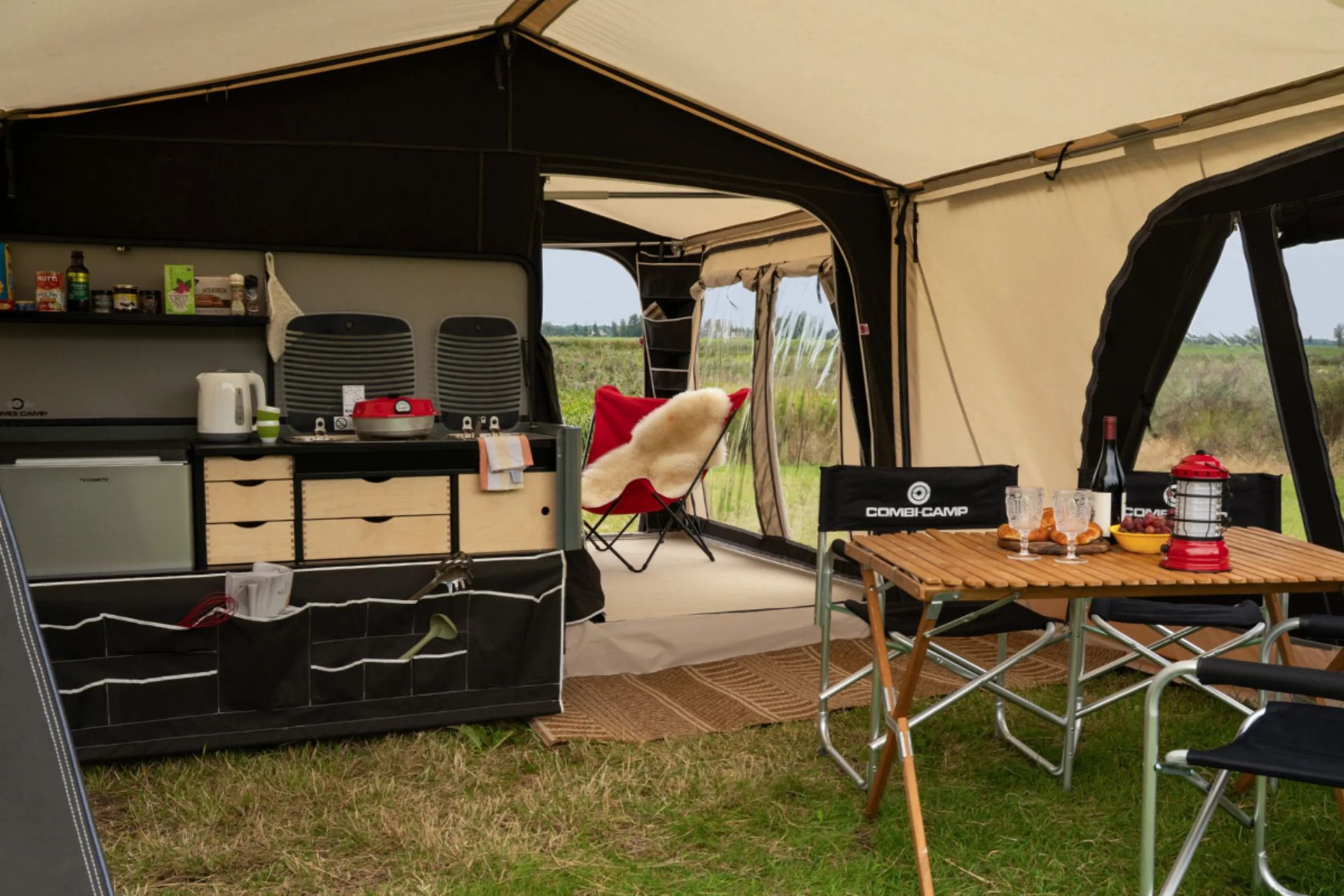
There is also a clever practical detail: the kitchen remains accessible while the trailer is packed for travel. That means users can stop during a journey and reach food or drinks without first unfolding the entire camper.
Once at the campsite, the kitchen ends up underneath the awning as part of the normal setup rather than needing to be lifted out and positioned separately.
Compact enough to tow easily
Despite the amount of equipment packed inside, the Country remains relatively compact when folded.
The version without a kitchen measures 364 × 168 × 115 cm (11.9 × 5.5 × 3.8 ft) including the drawbar. Adding the kitchen increases its overall length to 416 cm (13.6 ft) while width and height remain the same.
Empty weight is listed at 400 kg (882 lb) without the kitchen and 450 kg (992 lb) with it. A kitchen-equipped Country with the optional front storage box weighs around 500 kg (1,102 lb) empty.
Maximum permitted weight is 750 kg (1,653 lb), leaving a payload of 350 kg (772 lb) for the basic trailer, 300 kg (661 lb) with the kitchen or 250 kg (551 lb) when both the kitchen and front box are fitted.
Combi-Camp specifically describes the Country as suitable for pairing with an electric car, where trailer weight and aerodynamic drag can be particularly important considerations.
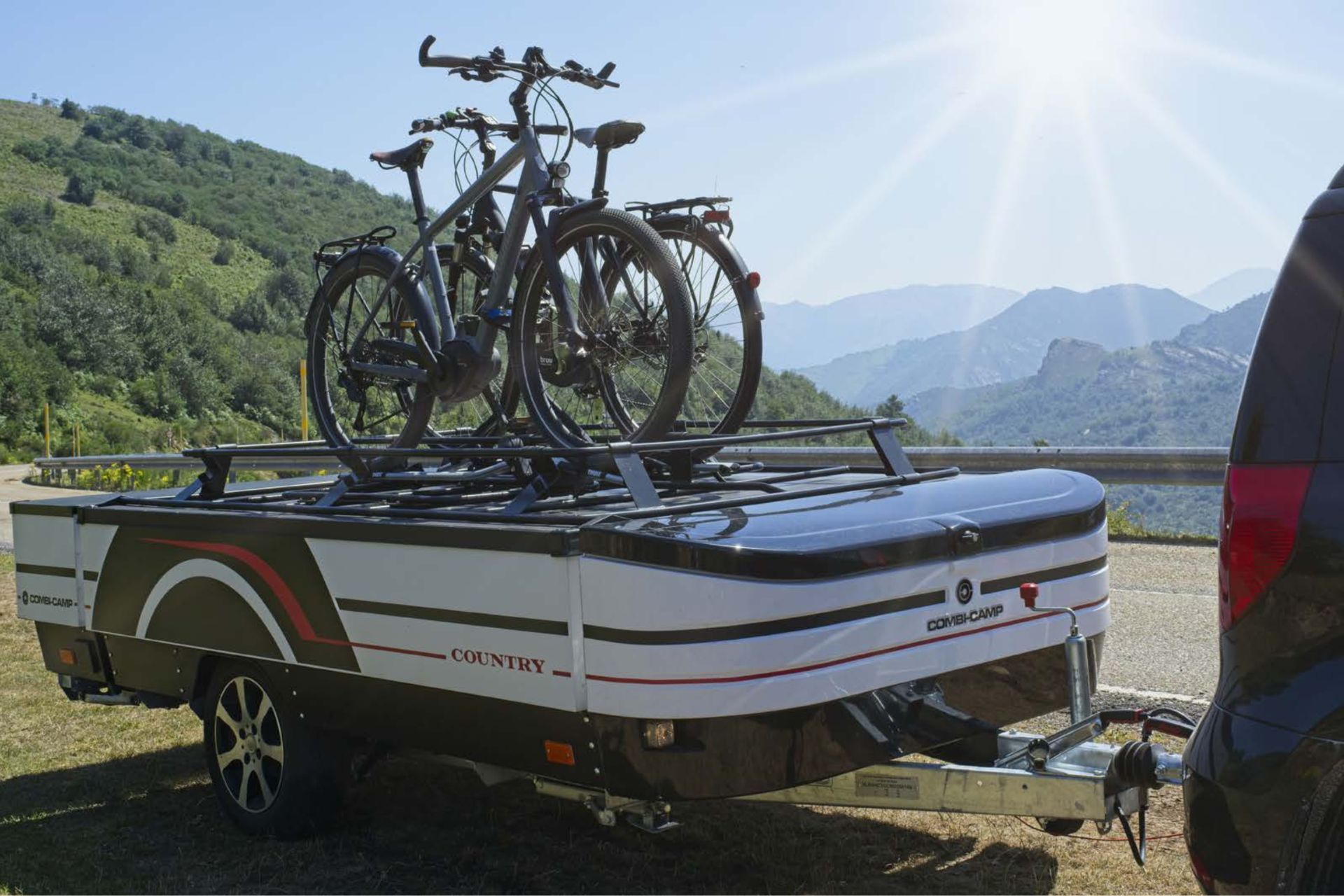
The standard equipment also includes an overrun brake, shock absorbers and a spare wheel, adding some proper trailer hardware underneath all that canvas.
Different fabrics and all-season options
Buyers can choose a white or gray trailer body, while several tent materials and color combinations are available.
Those include EcoHemp, Combi-Camp’s iQ fabric and conventional cotton options in several color combinations.
There is also an optional HEAT system, which Combi-Camp says allows the trailer tent to be used across different seasons.
Price and availability
According to the Combi-Camp product page, the Country currently starts at €13,995 (approx. US$16,180).
The Country with kitchen starts at €17,995 (approx. US$20,800) ex works Netherlands.
Those prices put it well beyond the territory of an ordinary family tent, but the Country sits somewhere between traditional tent camping and towing a caravan. You get a real bed, hard floor, substantial storage and optional kitchen, while retaining a trailer that is much smaller and lighter than most conventional travel trailers.
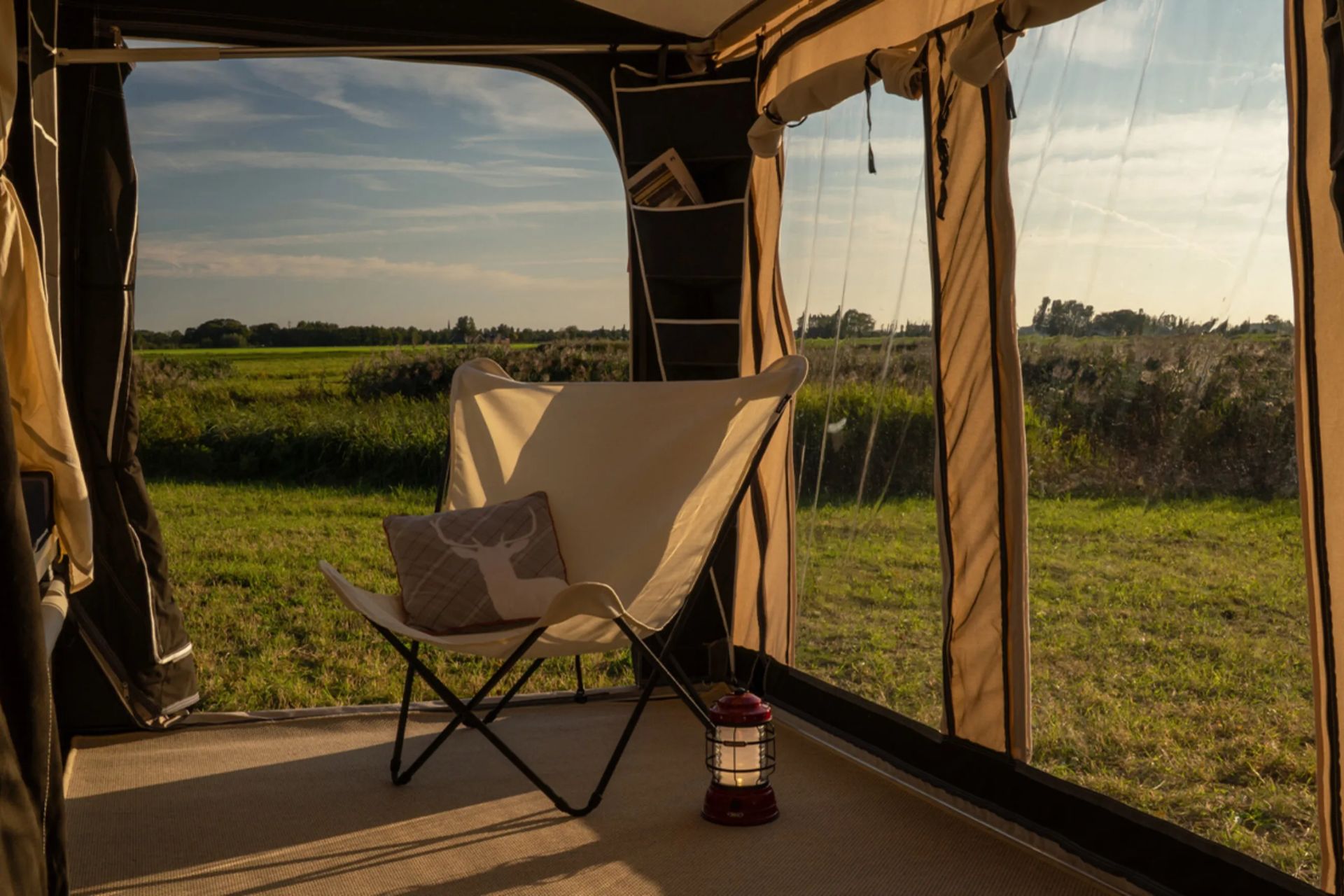
And arguably its most interesting feature is still the simplest one to demonstrate.
Arrive at the campsite with what looks like a small trailer, start unfolding it, and in less than a minute the basic bedroom and floor can be standing — without hammering a single tent peg into the ground.
Product page: Combi-Camp