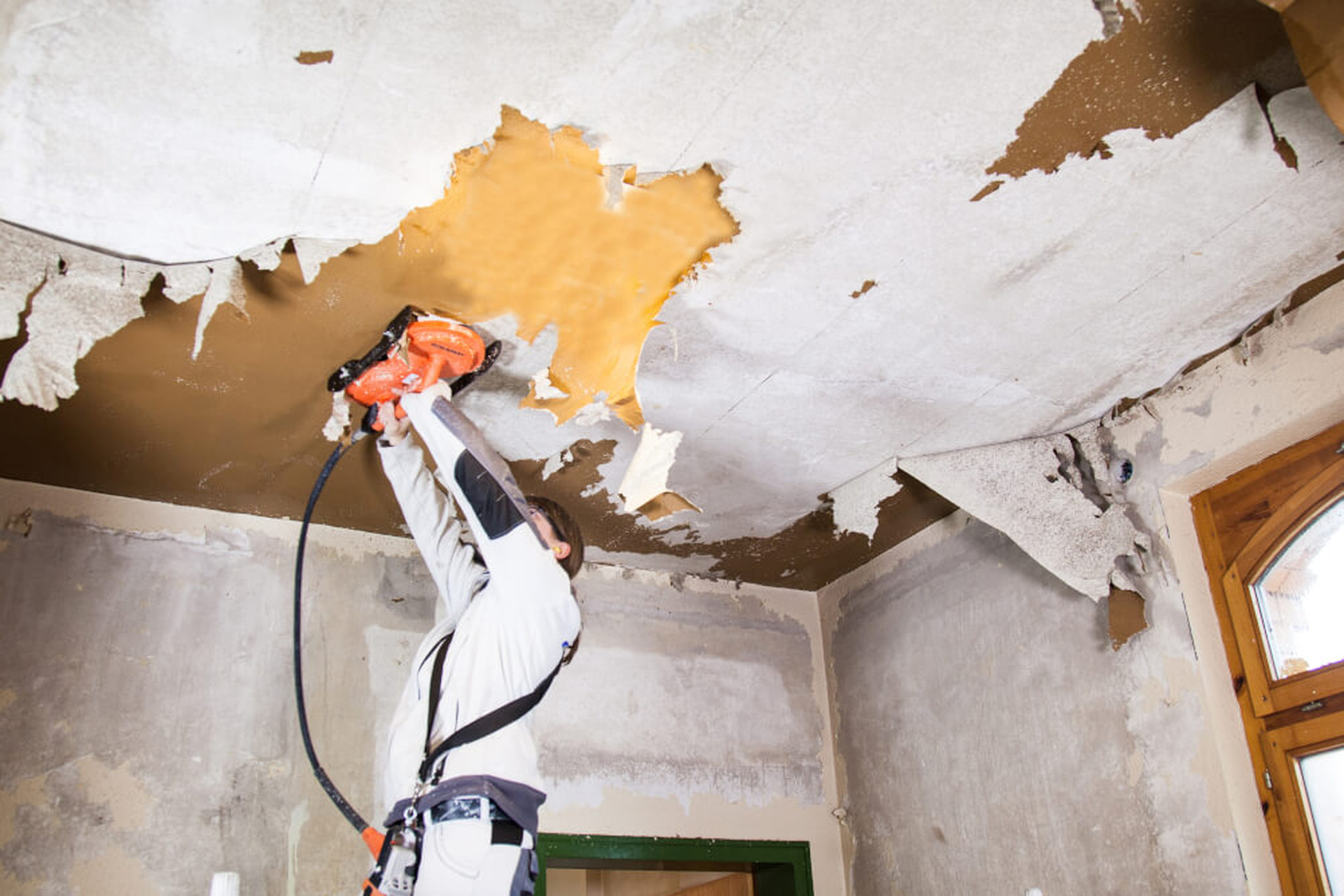
Removing an old wall covering can involve scoring the paper, soaking it and then working across the surface with a handheld scraper. Preparing the exposed wall may require an entirely different sander. The ROKAMAT Chameleon turns those and several other surface-preparation jobs into applications for one motorized platform.
Built for painters, plasterers and professional finishers, the Chameleon can sand insulation panels and drywall, remove wallpaper and old coatings, clean facades, smooth fresh concrete and polish selected surfaces. Its function changes with the pair of 200-mm attachments fitted to its unusual counter-rotating head.
A motor you wear instead of lift
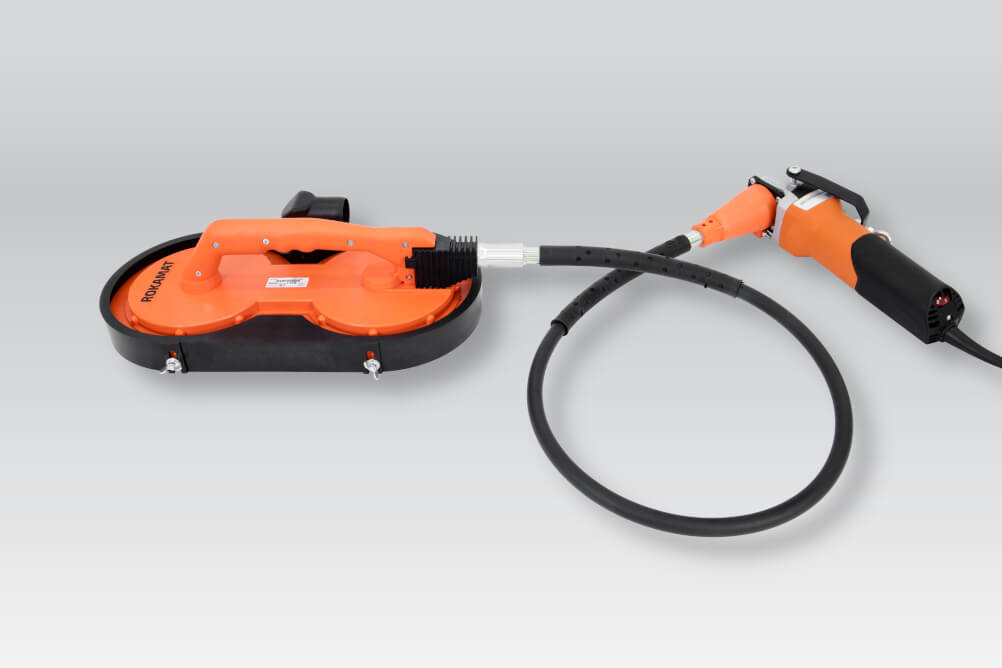
The Chameleon looks different from a typical wall sander because its motor is not housed in the working head. The operator carries the motor on the supplied belt or an optional shoulder strap, while a flexible drive shaft transfers its power to the handheld unit.
This arrangement puts the heavier components close to the operator’s body. ROKAMAT lists the hand unit at 2.4 kg (5.3 lb), compared with a total net machine weight of 5.3 kg (11.7 lb). That matters when the tool is being held against a wall or overhead for an extended period.
The corded motor is rated at 1,000 W and provides an adjustable no-load speed of 150–570 rpm. Its relatively low rotational speed is paired with high torque for working on plaster, concrete, wood, drywall and insulation materials.
Two discs work in opposite directions
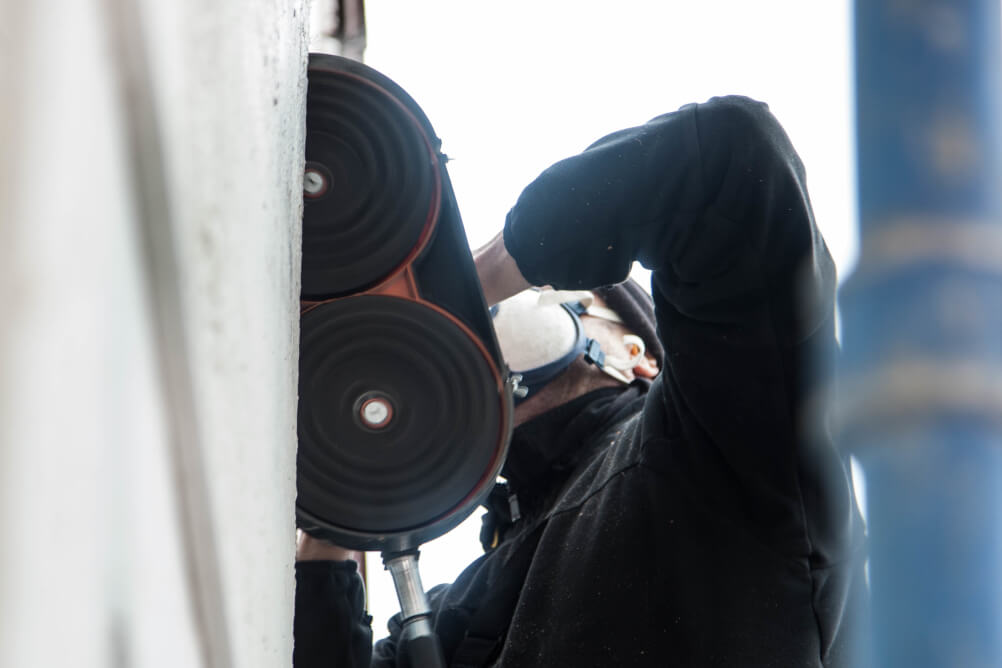
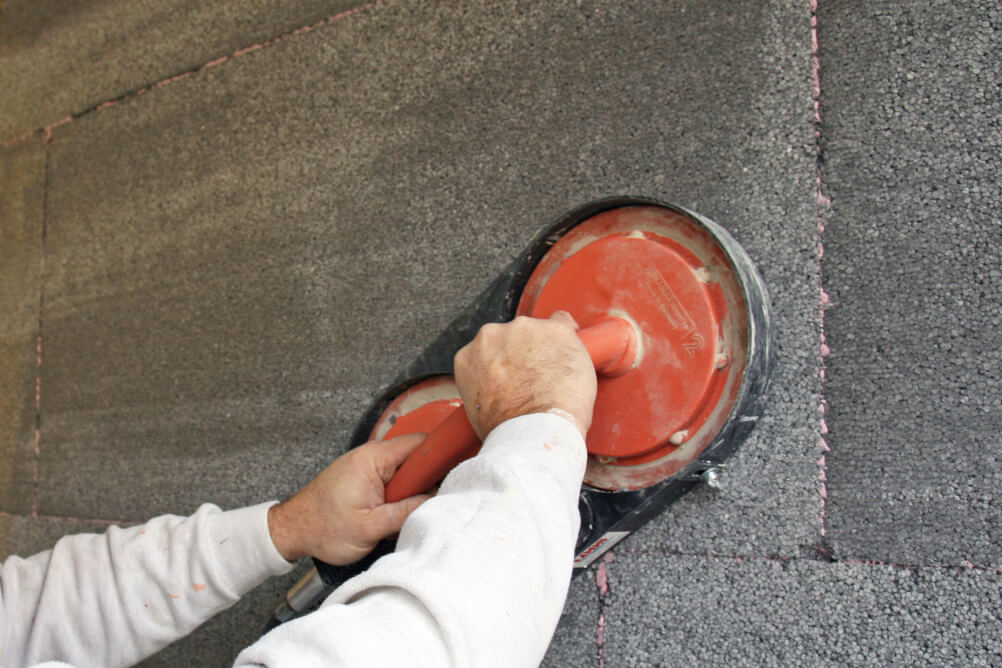
The handheld head carries two 200-mm (7.87-in) tool discs that rotate in opposite directions. Their combined area allows the machine to cover more surface than a small orbital sander or manual scraper, while the counter-rotation helps balance the forces that would otherwise pull the tool to one side.
ROKAMAT says the arrangement produces smoother handling and transports removed material toward the outside of the working area. The machine must nevertheless be operated with both hands. Its manual recommends beginning at the lowest speed, applying only enough pressure to keep the head flush, and moving it across the surface in overlapping passes.
An adjustable extraction hood surrounds the working attachments during sanding. Besides connecting to a suitable dust extractor, the hood acts as a depth limiter. Depending on the attachment, ROKAMAT recommends allowing the discs to project approximately 1–1.5 mm beyond the hood or guide rails. This can help prevent aggressive tools from cutting too deeply into soft plaster or insulation.
From wallpaper perforator to powered scraper
Wallpaper removal is one of the Chameleon’s most striking applications, but it requires the optional Premium Wallpaper Removal Kit rather than the abrasives supplied with the base machine.
The kit includes perforating discs, a scraper plate, sliding guide rails and six replaceable blades. First, the perforating discs create openings across the wallpaper so water or removal solution can reach the adhesive. Once the covering has soaked, the operator changes to the powered scraper, which works beneath the softened material as the tool moves across the wall or ceiling.
The guide rails act as spacers and limit blade penetration. This can make the process faster and more consistent than repeatedly working with a small manual scraper, particularly across a large room.
It is not a guarantee that every covering will peel away cleanly. Vinyl coatings, multiple paper layers, stubborn adhesives and poorly prepared substrates may require additional scoring, soaking or careful hand work. The operator also needs to select a depth that removes the covering without unnecessarily gouging the wall beneath it.
One drive unit, many attachment sets
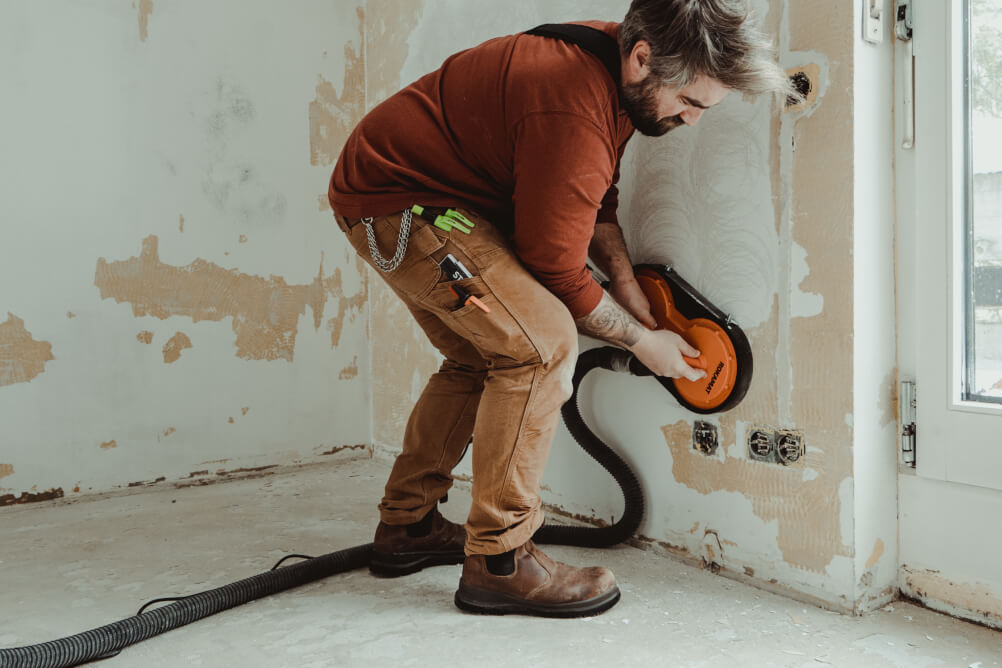
The Chameleon’s broader usefulness comes from its extensive accessory range. Available abrasive papers run from coarse K16 products used for shaping polystyrene insulation to finer grits for plaster, filler and drywall. ROKAMAT also offers grinding mesh, perforated JÖST Superpads and metal abrasive discs for more aggressive work on materials including timber, brick, screed and adhesive residue.
Different steel, stainless-steel and nylon brushes can be used for cleaning formwork, exposed concrete and facades or removing loose paint, moss, algae and plant growth. Other options include polishing pads, lambswool pads, carbide discs for old plaster and plates for smoothing fresh sprayed concrete.
Changing accessories does not turn the Chameleon into an unrestricted grinder. The manufacturer specifies approved attachments for each operation, and its manual warns against fitting accessories simply because they appear to fit the machine.
The standard package contains the universal machine, carrying strap, two 200-mm support plates, four K16 abrasives and a transport case. The wallpaper kit, specialist brushes, polishing accessories and dust extractor are separate purchases.
Dust control still requires a vacuum
Although the machine is frequently promoted for low-dust working, it does not collect dust by itself. The extraction port must be connected to a suitable vacuum, and ROKAMAT’s operating instructions require dust extraction during grinding work. The company also recommends an antistatic hose.
Actual dust control will depend on the attachment, surface, hood adjustment, hose, filter and extractor. Wind-lock, ROKAMAT’s US distributor, notes that the company’s backpack vacuum is not currently available in the United States, although the Chameleon can connect to compatible shop-style vacuums.
This is particularly important when disturbing old construction materials. Paint, plaster and masonry dust can contain lead, respirable silica, asbestos or other hazardous substances. Materials should be identified before mechanical removal begins, and operators need the appropriate extraction, respirator, eye protection and hearing protection. The published sound-pressure level is 91 dB(A).
The machine that created ROKAMAT
The Chameleon is not a recent addition to the company’s lineup. ROKAMAT says founder Rolf Kammerer conceived the original machine after experiencing the effort required to work scraped plaster by hand in his father’s plastering business.
The first version reached the market in 1982 with the same underlying idea: separate the motor from the handpiece to reduce the weight supported by the operator. ROKAMAT remains a second-generation family business, with its equipment designed, assembled and manufactured in Germany.
Pricing and availability
ROKAMAT sells through dealers rather than displaying a US price on its own product page. Wind-lock currently lists the Chameleon at $1,954, while Demand Products lists it at $1,661 without a vacuum. The German product page gives a recommended price of €1,267 excluding VAT. Prices and included components can vary considerably by retailer and market.
Buyers should confirm the voltage version, included abrasives and whether their intended attachment set is part of the quotation. A complete wallpaper-removal or dust-extraction setup will cost more than the base machine.
For contractors who repeatedly prepare large walls, the Chameleon’s appeal is not one extraordinary attachment but the ability to run many of them from the same lightweight hand unit. Its modularity will be excessive for a small household project, but on renovation and finishing jobs, replacing several specialized processes with one adaptable drive system could make considerably more sense.
Product page: ROKAMAT Chameleon